
I often remind my clients that taking things slowly is one of the most important parts of training a dog.
Which is why it’s slightly embarrassing to admit that, three days into learning how to crochet, I completely ignored my own advice.
I often remind my clients that taking things slowly is one of the most important parts of training a dog.
Which is why it’s slightly embarrassing to admit that, three days into learning how to crochet, I completely ignored my own advice.
This whole experience has been fairly solid proof that the phrase “do as I say, not as I do” is 100% accurate.
When I’m teaching my lovely clients and students, I regularly talk about the importance of repeating the basic skills. Practising the “boring” stuff until both the dog and the human really get it.
It might not feel exciting, but it works.
Those foundations are what lead to success, reduced frustration, lower stress levels, and a much more enjoyable learning experience overall.
Which is why, after just three days of learning three basic crochet stitches, I decided I was ready to make a granny square.
(Reader, I was not ready.)
To be clear, I did follow instructions — I’m not that reckless. But what followed was two further evenings of effort, over ten complete unravels, and a surprising number of swear words aimed directly at a ball of yarn.
Eventually, I did manage to make a granny square.
If you’re being generous with the word square.
If I had done what I tell my students to do — “practise the easy things until they’re second nature, then add difficulty” — I could have saved myself hours of frustration. And that ball of yarn would not have been launched across the room.
The following evening, I went back to basics.
I practised the same stitch over and over again. No project. No end goal. Just repetition. Getting familiar with how it felt, how the yarn moved, how my hands worked together. Trying to enjoy the process instead of rushing to the result.
And that’s when it really clicked.
Because even in crochet, there are so many things happening at once. How to hold the hook. How to hold the yarn. How tight the stitches should be. Which stitch comes next. How to count properly. And that’s all before you’ve even made anything recognisable.
For someone new to a hobby, that’s overwhelming.
So instead of trying to do everything at once, I focused on one thing at a time.
First, familiarity with the stitches.
Then, a very simple beginner project.
Then, paying attention to tension.
I made several small pieces, and with each one I got better — at counting stitches, at seeing where each stitch actually was in the mess of yarn, at controlling tension, and at making sure things ended up roughly where they were meant to be.
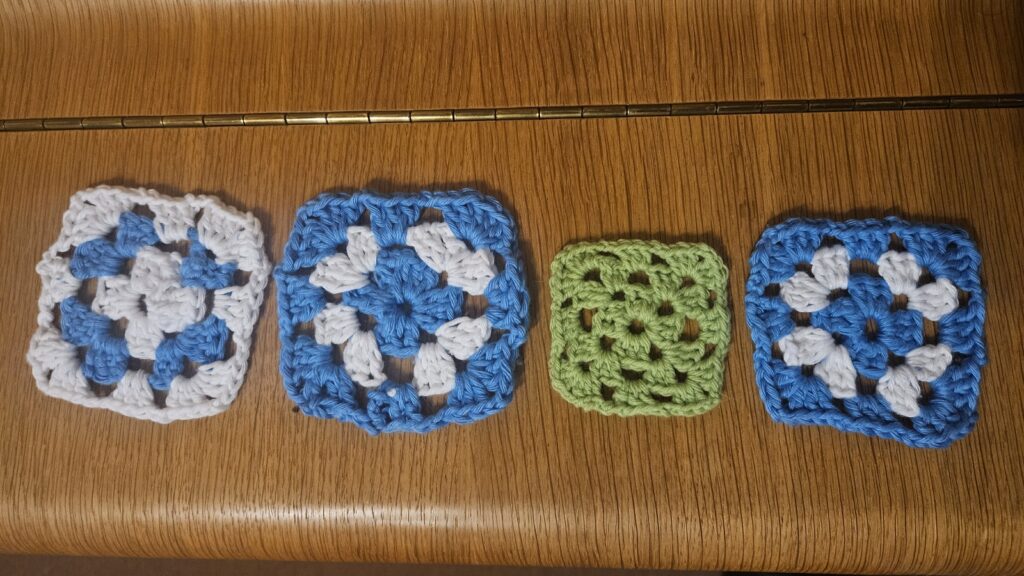
I couldn’t have done all of that at once.
One of the nicest things about crochet is that mistakes aren’t a disaster. If you spot one, you can go back a few stitches. You can unravel the whole thing if you want. Or you can leave the mistake in, finish the piece, and look at it later to understand why it happened.
That part felt very familiar.
With dogs, mistakes in training aren’t the end of the world either. Yes, repeated mistakes can take longer to undo – but a few slip-ups here and there are often brilliant learning opportunities. They tell you what needs more clarity, more repetition, or a simpler setup.
I’m still frustrated with the yarn sometimes. That hasn’t magically disappeared.
But I haven’t stopped enjoying the process of learning and creating. I’m getting better with every attempt, and I’m learning something new each time I pick it up — even when things don’t go to plan.
And when it does all come together, when something finally works, the outcome feels worth it.
Not because it’s perfect.
But because I know how much patience, repetition, and learning went into it.
If you’re feeling stuck with your dog right now, or frustrated that progress feels slow, consider this your reminder: slow doesn’t mean failing — it usually means you’re doing it properly.